Tuesday, June 27, 2006

Renaming God?


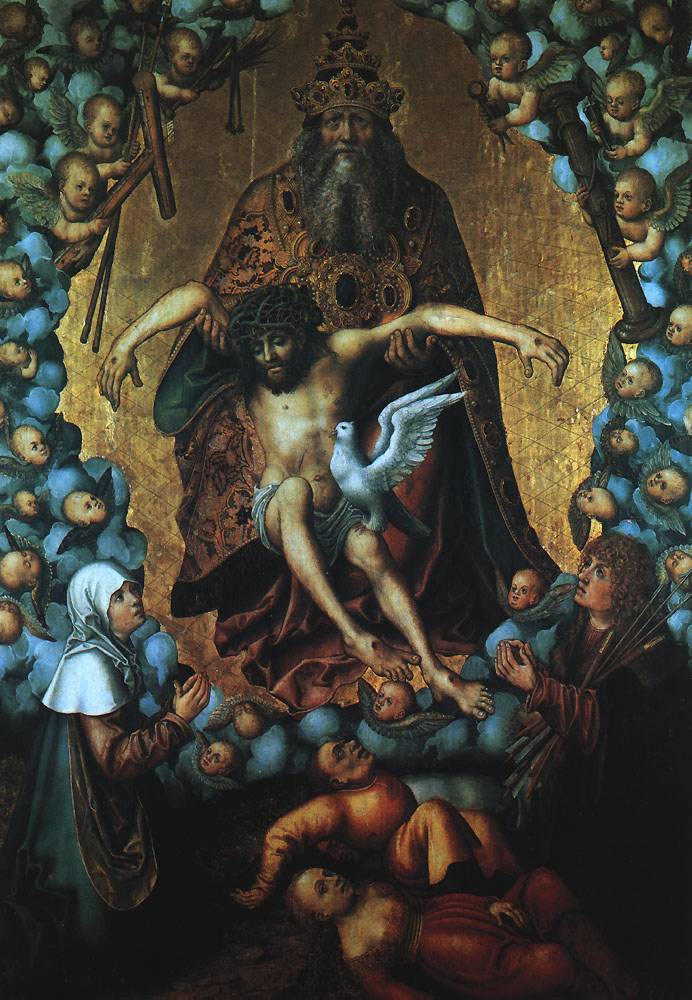
Summer is a time for annual denominational conventions, and, because of the occasional absurdity of what those conventions are debating, it is a time for loads of media coverage of American Christianity. Not the least interesting of these stories was last week's revelation that the Presbyterian Church (USA) received a policy paper recommending that the "Father, Son, and Holy Spirit" be allowably replaced with "Mother, Child, and Womb" as a way to refer to the triune God in worship services. How bad is this development for the PC (USA)? On one hand, the Associated Press names the reaction of certain conservatives that "the church should stick close to the way God is named in the Bible." This seems almost right, but the real issue is not that we must only use explicitly Biblical language for God (i.e. who would argue that it would be wrong to address God as the "Great Physician"?), or even that God does not have certain "motherly" qualities (cf. a previous post regarding places in the Bible where God is portrayed as a brooding mother-bird). The real problem is the desire to replace God's own self-determined names with names that explictly reverse the meaning of those revealed names -- even when the new name might carry some truth in it.
Here's what I mean: The first person of the Trinity calls himself "Father," and though he also reveals mother-like qualities about himself, this fact, for whatever reason, does not result in God also naming himself in the Bible as "Mother." Why not? In the end, you and I don't know the answer for this, nor do we have to know. Somehow, the Father-metaphor is more central to God's character, more helpul for us to know, whatever -- but "Father" is what he has chosen to call himself, rather than "Mother". To substitute "Mother" for "Father" is different than calling God "Great Physician," since doing so does not reverse any other name that God has chosen to reveal.
Another trend in the Scriptures that helps to make the same point: God reveals certain qualities about himself by way of metaphor, others by way of simile. Metaphors say "A is B" while similes say "A is like B". I.e. Jesus "is" the Son, but is only "like" a mother hen (Luke 13:34). Of course, one could do a lot of unwarranted speculation about why God chooses some names as metaphors and other self-descriptions as mere similes, but it's an easy, organic, and biblical way to name God by using the metaphors, and not to try to reframe the similes as if they could as easily become metaphors. I.e. to start calling Jesus our loving "Hen" is to turn a simile into a metaphor. This is not an insignificant move, but is a kind of genre-violation of God's own modes of self-naming. Language does matter, and for reasons we can't always name.
The impulse to rename is sometimes legitimate and a sign of affection, of course -- we give endearing nick-names to our spouses and kids -- but this habit becomes immediately subversive (wouldn't you say?) when we do it to those in authority over us. To call a civil court judge "Pops" is partly appropriate as to the nature of his authority, but definitely disrespectul. And, since God exercises his authority over us lovingly, for our benefit, even the names he has chosen for himself carry some form of a gift, even if we don't always see it.

Thursday, June 22, 2006

Getting into the Psalms


In about 381 AD a Christian woman named Egeria set out on a pilgrimage to Jerusalem from her native Spain, and wrote a travel-journal of her experiences. Among the other wonders of her story (it's still in print, by the way) is what she reports about how ancient Christians conducted their public worship services. Now, nothing that's old is worth repeating merely because it's old, but getting a viewpoint from a different millenium and a different culture has its value. And what the early Christians seemed to value was the Psalms. For example, the basic daily morning services she would have encountered in Jerusalem opened with either Psalm 50 and 51 or 62 and 63, then several other variable Psalms were read (or sung), then an Old Testament "canticle" (like a Psalm), then Psalms 148-150, followed by various prayers and a blessing. While the services she attended had been heavily influenced by "monastic model" worship practices and their even heavier Psalmody, these "cathedral model" services of the average Christian were very Psalms-rich.
What's great about the Psalms? They marry theology and poetry, doctrine and personal experience, and model how the whole range of human emotions can be expressed to God through through prayer. The Pslams teach us how to pray, and praying them ourselves gives us words to say to God that we might have difficulty expressing on our own. Since the Psalms are also inspired by the Holy Spirit, they are God-endorsed guides that we can trust, and keep us from being lopsided in our own self-made prayers. For example, praying the Psalms over time keeps us well balanced between praise, thanksgiving, repentance, and requests for God's help.
Christians have the advantage (and duty!) of praying the Psalms in light of Christ -- which will help us to make use of many Psalms that might otherwise seem too locked-in to an ancient time and place. Here are few tips: When there is a dialogue between "the king" and "the LORD" in a Psalm, think about Christ as that king. While David was the historical king who wrote the dialogue, Christ is the "Greater David," and many of these Psalms amazingly illuminate Christ's relationship with the Father, especially while he was on earth and depending on his Father while on the way to the cross. We can worship as we rehearse how Christ was in league with his Father in their joint project to save their people. Another tip: when the Psalmist calls out to God for the destruction of his enemies, remember that the three main enemies of the believer in this life are sin, death, and the harassment of the devil. While David had earthly enemies who he could pray against very strongly because of his particular call by God to maintain an earthly kingdom, we are citizens of Christ's spiritual kingdom that is presently more concerned about spiritual enemies. So, don't pray brimstone down on your cranky office-mate, but do pray it down on your own sin-nature and the work of the devil in the world. Again, when the Psalmist praises God for his rescue of his people at the Red Sea, remember that the Exodus is a foreshadowing of Christ's greater rescue at the cross -- realizing this will allow you to use many Psalms word-for-word while praising God for the greater Exodus by which he saved us. Likewise, the Psalmist warnings against abandoning God in the Sinai desert can be read as a warning to the church to not forget the God who has brought them into such freedom through Christ. With a few such New Covenant adjustments to our interpetation, we can see why the Psalms are just as useful for the Christian as they were for Jews before Christ.
Now a very practical idea. If you'd like to go through Psalms in a month, read the Psalm that has the number of the current date, as well as the current date plus 30, 60, 90, and 120. So, on June 22, you'd read Psalm 22, 52, 82, 112, and 142. That's a lot in one day, but still less than a lot of Egeria's new friend's were reading! Personally, I'd say to go slow and try to pray as you read. There's no shame in taking ten or more minutes per Psalm (or even an hour). You only might finish one Psalm in a sitting, but at least you're on your way. Enjoy meeting God through his own words!

Friday, June 16, 2006

Book of the Month


One of ongoing problems in contemporary theology is how to best relate "systematic theology" and "biblical studies." Here's the problem: if a person starts with a somewhat formed view on any of the traditional subjects within theology (such as the nature of God, the Bible, the person and work of Christ, the role of the Holy Spirit, etc.), he will have a hard time being unbaised when he is trying to interpret any individual text of the Bible. He'll be tempted to sift scripture through his predetermined theological grid, and so, individual texts will have less chance to challenge or correct his views. His pre-textual framework will decide beforehand which texts are essential and determinative and which are odd anomalies that are "exceptions to the rule." But the other problem comes when someone seeks to do biblical studies without reference to systematics, that is, to interpret any individual text without reference to what the Bible says elsewhere on the same topic. To refuse to engage in systematics makes one forever a mere child -- never growing in wisdom as the broad strokes of the whole Scripture sink in. Such a path also tends to arbitrarily deny the organic nature of the Bible, that is, that, Christianly speaking, the Holy Spirit is behind the whole project of Scripture, and that Scripture therefore fundamentally agrees with itself and invites some form of systematization (while being sensitive to various genres, historical contexts, etc.).

Enter Covenant Theology. A long-tradition, perhaps begun in earnest by the early church father Irenaeus (2nd century AD) and massively expanded by Protestant Scholastics in the 16th and 17th century, Covenant Theology seeks to make some inroads to solving this age-old problem. To grossly oversimplify, Covenant Theology suggests that the organic structure of the Bible is covenantal, that is, the unfolding drama of Scripture is strikingly organized around various "covenant administrations" between God and his people. Scripture does not just tell us about these covenants, rather, covenants are the basic "architectonic principle" (Horton's term, I think) of both testaments. So, while this observation definitely sees some "system" to scripture, it is a system that is in every imaginable way inherent to the text, not forced on it from above. The covenantal superstructure of Scripture has been made even more clear after various acheological discoveries of the 20th century showed that whole books of the Old Testament bear remarkable literary-stuctural similarity to ancient near-eastern treaty formulas. When all of this is understood, an extremely organic way of connecting biblical texts to systematics starts to arise. If this is unclear, it's because I've left out all of the specifics, but hopefully a post of this short lenth will be enough to at least whet your appetite.

Michael Horton's new book God of Promise: An Introduction to Covenant Theology is a good place to dive into this amazing field (O. Palmer Robertson's Christ of the Covenants is the older, simpler, intro), though, by any counts, it's for advanced beginners, at least. Horton was my dissertation advisor, so I'm a little biased, but I do think his last two academic titles (with a finale on the way) have done a lot to advance Covenant Theology in dialogue with a range of unlikely modern conversation partners. Not exactly summer reading, I guess, but it is a worthy book for anyone's 2006 reading list. Start here, then if you're really ready to take the plunge, try his Covenant and Eschatology: The Divine Drama and Lord and Servant: A Covenant Christology to see how other areas of systematics are helpfully impacted by attention to the Bible's own covenantal structures.

Friday, June 09, 2006

Whatever Happened to Chanting?


In light of my last post on clergy shirts, the topic today might contribute to the rumor that some kind of hyper-traditionalism has overtaken this site. That is not the case, and yet, the question today is "whatever happened to the practice of chanting in Christian worship services?" Perhaps I should mention that I am one who has never chanted a word in any service I've led. Chanting has never been tied to one particular branch of the church, so the numerical rise of one branch over any others can't be the answer for its general demise. (As evidence for this, compare Lutheran, Presbyterian, and Episcopalian worship books from a few decades ago -- they all have rubrics for chanting various prayers, Psalms, and biblical texts.) The rise of informalism could be the culprit, but informalism hasn't killed-off music or singing in general, and many forms of chanting are actually more simple than praise choruses. In fact, just learning a handful of chants would make the entire Psalter singable. How easy is that? Chanting provides some of the same benefits of singing longer melodies - it gets the truth of the words deeper into the heart, sort-of romancing us with what is said. Even other religions recognize this -- Muslims, Jews, and Hindus are big chanters, even today. Some Protestants might say that chanting sounds too medieval or Roman Catholic, but that response tends to be a catch-all rebuttal for any church practice that doesn't have roots in the Second Great Awakening. Chanting a few scripture readings in Sunday services might emphasize that we're to worship as we hear the Word read, and not just listen for content. Again, I welcome comments.

Friday, June 02, 2006

On Wearing a "Dog-Collar"


I have an old friend, about my age, who is an Anglican priest in a very orthodox American denomination of churches who have either broken away from, or never joined, the liberal Episcopal Church U.S.A. Brian is a rather high-church sort-of a fellow, which means that whenever I meet with him he's decked out in a clergy-shirt and a large cross necklace. Last week we met for a meeting in a local saloon, and he was wearing his usual "clerical," except this time with shorts. Needless to say, he tends to turn a few heads. But more interestingly, he also attracts a lot of people who want to talk to him about God and their souls. About two years ago I was late to meet him in another restaurant, and by the time I got there he was, somehow, holding court at the bar with several drinkers who had layed into him with all manner of theological questions. I asked Brian about this phenomena, and he said when he is wearing his collar he is routinely approached by people in the street who want to get right with God, confess their sins, etc. Routinely.
Many of us who do full-time church ministry wish we had more contact with non-Christians, more chances to get out of the church-ghetto and into real conversations with people who may be asking important spiritual questions. In light of Brian's experiences, putting on a clergy shirt and walking downtown sounds almost too easy. I've started doing a little on-line research on the topic and have found many similar testimonials from pastors who simply don the collar, and watch the sparks fly. What might happen if a pastor were to put on a collar, take a seat by himself in a bar or coffeehouse, and just wait? I'm contemplating running this experiment myself. Some of the standard objections to wearing a collar don't quite stand up, either. The clergy shirt has no historical tie to Roman Catholicism, as some fear, since the typical clery shirts styles were first used by Protestants. How about the potential problem overly distinguishing a pastor from other Christians, i.e. somehow denying the "priesthood of all believers"? Martin Luther, the first developer of that doctrine, still wore some form of distinct attire, as do most Lutheran pastors (at least while conducting services). Most Protestant denominations have used collars at the discretion of the individual minister, though the practice seems to have declined in the mid-twentieth century when clergy were trying to de-emphasize the clergy/laity distinction. But, I'd argue, whatever else the priesthood of the believer means, it does not erase the distinction in calling between the believer who is an ordained minister from the believer who is a doctor, engineer, construction worker, etc. The shirt simply communicates, "I'm a pastor" in the same way that other dress communicates "I'm a pilot," "I'm a police officer," "I'm a dentist," etc. And, to wear to the collar in public really would seem to say, "I'm a minister, and I'm on the job. How can I help you?" It's almost too easy.

For a lot more info on this, check out www.kencollins.com/pray-26.htm and as well as a pictorial guide to "clericals" (street wear) versus "vestments" (attire for use during public worship) see kencollins.com/glossary/vestments.htm.

Friday, May 26, 2006

The "Christ" is Jesus' Last Name Problem


What if we took a break from saying "Jesus Christ" and instead went with "Jesus the Messiah" or "Jesus the Anointed"? Here's my rationale: Technically, when we say "Christ" we are merely transliterating the Greek noun "christos" rather than really translating the word into English. That is, "Christ" doesn't have any meaning in the English language outside of a moniker for Jesus, which is why some people, understandably, think it must be just part of Jesus' given name. "Christos" translates the Hebrew word "messiah," and comes into English as "anointed-one." All to say, when the Bible calls Jesus the "Christ," it is actually communicating something about Jesus' mission, the purpose that the Father had appointed for him. To start calling him "Jesus the Anointed" would remind us that Jesus was called and equipped by God for a specific kingly, priestly task (kings and priests were both anointed in the Old Testament). Many people these days are rightly acknowledging that the most recurrent theme in Jesus' own teaching about himself is that he had arrived to inaugurate his Father's kingdom, to put-the-world-to-rights (as N.T. Wright likes to say). Whenever the New Testament writers call Jesus the "Christ," they are reminding us that Jesus is God's chosen-one, Israel's messiah who was sent to be the world's rightful Lord, that this Jesus has personally brought the beginning of the end of history, as all the old prophets had anticipated. To many people, the untranslated word "Christ" does not communicate any of this rich meaning (though certainly, we can train ourselves make such an association in our heads whenever we hear "Christ"). To start calling Jesus "the Anointed" would immediately raise the question "anointed to do what?" - and of course, the answer to that question is what matters most about Jesus. Any thoughts, readers?

Friday, May 19, 2006

N.T. Wright at City Church of San Francisco


As promised, here's a short review of the event last Monday night. I drove up to the city in time to catch dinner with Rev. Mike Hayes of City Church, then over to the Russian Center. N.T. Wright, the Anglican bishop of Durham, spoke to a packed house of mostly twenty and thirty somethings. To see some five hundred young people cram-in to hear a lecture about theology from a former Oxbridge don, in San Francisco no less, is surely good news for the future of the world. The lecture was mostly Wright summarizing his new book, Simply Chrisitian: Why Christianity Makes Sense, which has a chance at being the next Mere Christianity in terms of its hyper-accessible, smart, appealing introduction to the Christian faith. The hook of the talk (and the book) is Wright's observation that all human beings hear four "echoes of a voice": a desire that the world be more just and fair, a drive for some spiritual connection, a yearning for relationships, and an awe before real beauty. While these voices are universal, they are mere whispers, since none these yearnings are ever quite satisfied or explainable on their own terms. From here, Wright shows how the story of God's creation of the world, its fall, and its recreation through Christ and his kingdom makes the most sense of these vague yet persistent voices. Because God's new creation has been inaugurated in the arrival Jesus Christ in Palestine, God's justice is on its way, a path to spiritual union with God has been opened, the possibility of a renewed human commmunity has begun, and a glimpse of the truest beauty has appeared. These are different ways to introduce the old Christian doctrines, but (especially in the book) Wright gets around to the Trinity, person and work of Christ, etc. Of course, new creation themes make up the dominant doctrinal framework for Wright, which sometimes to me seems reductionistic when it comes to the atonement. The book is worth the read though, and especially good for post-modern types who might be specifically suspicious of traditional Christianity. Is it the Mere Christianity of the 21st century? Time will tell.

Sunday, May 14, 2006

Gettin' on the Bus for N.T. Wright


If there was such a thing as a rock star of theology living today, it would be N.T. Wright. The slightly plump, bearded, vestment-wearing, sixty-something Anglican bishop might not say so himself, but the fact is that he inspires groupies as well as super-fans, those who swear he's reinventing the study of the New Testament. I, for one, am not quite a super-fan, but I am about to inconvenience myself and my family tomorrow in order to drive four hours to hear him speak in San Francisco (heck, even moderate fans of U2 would drive that far to hear them play). Beyond the rock-and-roll analogy, N.T. Wright is a serious scholar at the fore-front of what has been called the "Third Quest for the Historical Jesus." In case you missed the first two quests, they began in the 1700's and are just recently winding up. These quests, as they are known, tended to conclude that the Jesus of history was either a "pale Galilean" who was very sweet and mostly talked like Robert Schuller, or, a New Age guru who tried to get everyone to wake up to their inner deity. He certainly did not do miracles or rise from the dead. The interesting (and amazing) news is that many of these conclusions about Jesus are no longer in theological vogue, giving way to a Jesus that looks a lot like a first century Jew who might have actually known something about the Torah (how uncouth!) and, the biggest surprise, may well have been painted fairly accurately by the Gospel writers (at least Matthew, Mark, and Luke). What's more amazing is that this family of scholars is simultaneously academically respectable even to those who disagree with their conclusions, and, their conclusions about Jesus are relatively orthodox. I've tangled a little with N.T. on this blog, but I'd still agree with the super-fans that he's the most widely influential scholar in theology today. I'm heading up to hear him speak to a fairly small group of folks at City Church of San Francisco surrounding the release of his new book Simply Christian. I'll make a report here later in the week.

Monday, May 08, 2006

Da Vinci Code Absurdity of the Week


This week's selection comes from page 240 of the illustrated edition: Dr. Teabing says, "Don't get a symbologist started on Christian icons. Nothing in Christianity is original. The pre-Christian God Mithras-- called the Son of God and the Light of the World-- was born on December 25, died, was buried in a rock tomb, and then resurrected in three days...the newborn Krishna was presented with gold, frankincense, and myrrh. Even Christianity's weekly holy day was stolen from the pagans."

Well. Scholars distinguish between two periods of Mithraism, the early Persian original, and a much later Roman version that appeared in the West at the end of the first century, at the earliest. So, the only version that early Christianity could have conceiveably borrowed from was the Persian variety. The Persian Mithras was a cattle herder who was born of a woman who got pregnant by swimming in a lake that happened to have the 400 year-old sperm of a god in it. This Mithras was not resurrected from the dead. The Roman post-Christian Mithras may have had more similarities with Jesus, but the charge of copying is as easily reversed in that case, since the canonical Gospels were in circulation far earlier than Mirthraism. Teabing's reference to Mithras' burial and resurrection on the third day (and Krishna's birthday gifts) seems to be lifted in toto from Kersey Graves' discredited The World's Sixteen Saviors, an outlandish book of undocumented claims published in 1875 (for example, no Hindu texts before 300 AD even discuss Krishna's birth, and the later Harivasma Purana, which does, makes no reference to "gold, frankincense, and myhrr.") Is the Christian Lord's Supper a rip-off of a Mithraic "god-eating" ritual, as Teabing also suggets? While Mithraism features a ritual consumption of bread and water (possibly wine), there is no evidence that it was interpreted as an act "god-eating." Even if it was, the Christian Lord's Supper is obviously rooted in the much more ancient Jewish Passover meal which predates any form of Mithraism, Persian or not. As for Sunday worship being "stolen from the pagans," Jesus resurrection on Sunday, as reported in the Gospels, is the real source for that day being hallowed. Again, remember the timeline: the honoring of Sunday as "the Lord's day" (cf. Rev.1:10 and 1 Cor.16:2, for example) arose within the first century, centuries before the pagan Emperor Constantine created a "hybrid-religion" (Teabing's words) bewtween Christianity and paganism. One wonders if Dr. Teabing's doctorate was really issued by a diploma-mill!

Tuesday, May 02, 2006

Newsweek, Judas, and Me


I was surprised to find a letter I wrote to Newsweek appearing in their May 1st issue. You faithful readers at enormoushippo were the first read my praise for Newsweek's Gospel of Judas coverage in my April 16th posting. After I blogged about the Newsweek article, I sent a letter to the editor, which then appeared two weeks later in print. Since Newsweek has a circulation of 3.2 million, I have likely now experienced the peak audience that anything I write will ever reach. That fact is simultaneouly exhiliarating and deflating. For the remaining 277 million Americans who don't get Newsweek (as well as you international readers), here's the letter they printed:

"Your good coverage of the Gospel of Judas puts the brakes on our readiness to grasp at any newly discovered ancient text that happens to mention Jesus as a reason to rewrite his whole history ("Sealed with a Kiss," April 17). As David Gates reminds us, the Gospel of Judas was written awfully late to play any such revisionist role. Don't get me wrong -- I'll be interested to eventually read the Gospel of Judas -- but as a study of a later variant on the earlier form of Christianity which was based on the much older canonical Gospels, not as a new source for what really happened during the days leading to Jesus' crucifixion."

Monday, April 24, 2006

Da Vinci Code Absurdity of the Week

A few weeks ago I made a tentative decision to stop writing about the Da Vinci Code because thought I'd run the risk of making this blog too repetititive, and perhaps because I'd come off as too much of a crank. I've changed my mind. Since the movie is still on the way, we have at least another couple of months where the ideas of the book will be as hot as ever (as depressing the thought of that is to me!). I also just started teaching a class on it at our church, so everything is fresh in my mind again. Here's the format I'll try in this and future posts: I'll quote a sentence or two from the book, and then make a few comments on why this quote qualifies as "A Da Vinci Absurdity."

This week's selection comes from one of the many historically revisionist speeches of the character Leigh Teabing. He says,"Constantine commissioned and financed a new Bible, which omitted those gospels that spoke of Christ human traits and embellished those gospels that made him godlike." The hint of truth: Constantine did commision the copying of a few dozen Bibles after the Council of Nicea in 325 AD. The absurdity: the list of Gospels included were only what anyone would have expected -- Matthew, Mark, Luke, and John. These Gospels were not in dispute as the historically reputable ones by anyone at the Council of Nicea. So, Constantine was not pulling a fast one, nor did he even personally act as the Bible's editor. Also, no evidence whatsoever exists to suggest that these Gospels were "embellished." On top of this, the four canonical Gospels, far from supressing ideas of Christ's humanity, are replete with his humanity. The critique of the Gnostic Gospels was, in fact, that they are the ones that diminish Christ's true human nature by turning him into some kind of phantasm that only appears to have had human flesh. Orthodox Christianity, from the earliest of times, claimed that Christ was fully God and fully human -- and this conclusion came because the four canonical Gospels emphasize both of those things. That Christ was fully human was not something that the early church denied or tried to supress as Dr. Teabing suggests -- in fact, Christ's full humanity is one of the most fundamental articles of faith as even the Nicene Creed itself alludes to.

Tuesday, April 18, 2006

Is Christian Salvation Other-Worldly or This-Worldly?

(My apologies to anyone who just read a shorter version of this entry that I just posted on JollyBlogger.)
A hot-topic in theology circles these days, especially in light of the rise of the "Emergent Church" movement, is whether or not the kingdom that Jesus Christ came to announce is more about a life-after-death place we go, or an entire overhaul of the present created world. My contribution to the debate: salvation is both of these things.
Despite what we might think about his whole theological project, N.T. Wright nails the biblical theme of salvation as "new creation," proving that the scripture really does underwrite some of the renewed interest in going beyond the language of mere life-after-death. The "heaven" of the book of Revelation is really more like a fabulously renewed earth than a wispy, cloudy, world of disembodied, blissful souls. Yet, (and this is a big "yet"), the fulness of the renewed future creation is only experienced by those who pass into it through a physical death (and dying in Christ no less), and then, a future bodily resurrection and vindication at the judgment seat of Christ (cf. 2 Cor.5). This "new heavens and new earth" is not an inevitable inheritance of anyone who lives on earth today, nor a reality that we can realize through any degree of sanctified efforts at cultural reform. The present world, and all of its history, must draw to a close at the moment of a future cataclysmic judgment, before that new creation will be brought to fruition. Most of us will experience this as a life-after-death reality. Until then, of course, we should get busy making the world more kingdom-like in ways that we can -- to do so proves that we have a theology of creation/re-creation, and not just a theology of the redemption of souls. There is, in fact, no room for the view that we shouldn't bother improving this world since it's all "going to burn."
But there is no ultimate conflict between a life-after-death understanding of salvation and that of a renewed creation. The mistake would be to pick either emphasis and make it its own "camp" from which to judge the other perspective as entirely wrong-headed. No surprise, the biblical view of reality, even heavenly reality, is not so easily summarised by just one metaphor, one image.

Sunday, April 16, 2006

Newsweek on Judas


Continuing the theme of giving credit where credit is due in media coverage of the Gospel of Judas, let's pause to considerer these wise (even punchy) words from Newsweek's David Gates:

"Don't be expecting this fragmented manuscript to read like the King James. Small sample: " '[Truly] I say to you, [ ... ] angel [ ... ] power will be able to see that [ ... ] these to whom [ ... ] holy generations [ ... ]' After Jesus said this, he departed." And not a minute too soon. The secret wisdom Jesus confides—when he's not laying out a hierarchy of angels, gods and more gods that makes Hinduism sound minimalist—is a lot like that of the Gnostic Gospels, which posit a strict enmity between flesh and spirit..."

"Robinson, who tried to acquire the manuscript again in 1993, says the Gospel is a sensation—but only to scholars, not the public. His own book, "The Secrets of Judas," hardly oversells the translation. "It tells us nothing about the historical Jesus, nothing about the historical Judas," he told NEWSWEEK. "It only tells what, 100 years later, Gnostics were doing with the story they found in the canonical Gospels. I think purchasers are going to throw the book down in disgust." But right now, people are loving the idea that Jesus and Judas were dear friends who were in it together—it's such a downer to think the guy sinned and felt bad—and the hoopla machine is grinding away. The book. The book about the book. The National Geographic TV show about the book and the book about the book. The audiobook. (Can't wait to hear the passage above.) Last week, the public unveiling of the manuscript. Next year, the illustrated critical edition. Can the lipstick tie-in be far behind?"

Tuesday, April 11, 2006

The New York Times and Judas


Accolades to John Wiford and Laurie Goodstein for their balanced treatment in the New York Times of the Gospel of Judas on April 7th. They mention that the real debate is not whether the document is ancient, but over it's relevance (presumably, they mean, to the question of Jesus studies). Those experts who they go on to quote as representatives of the pro-gnostic side of this new debate show how limited the scope of this whole conversation will really be. In other words, the relevance of the discovery is not so much to a possible redrawing of old lines about the historical Jesus, about which all late-dated gnostic Gospels are dubious source texts, but relevance merely to the nature of second and third century beliefs about Jesus in certain sub-sects. One of the champions of gnostic Christianity, Elaine Pagels, is quoted as saying that discoveries of this and other gnostic texts "are exploding the myth of a monolithic religion and demonstrating how diverse — and fascinating — the early Christian movement really was." She's right, though one wonders if anyone ever believed such a myth (though again, the truly "early Christian movement" of pre 70 A.D. shows very little of the diversity that Pagels revels in). The Gospel of Judas will be a fascinating read, but only as it gives insight into a highly marginal (even among Gnostics?) religious community and their imaginings about Jesus and Judas.

Thursday, April 06, 2006

Betraying The Gospel of Judas


Today's big story in religion is the unveiling of The Gospel of Judas, a 1,700 year-old Coptic document that purports to record a secret conversation between Jesus and Judas, where Jesus asks Judas to betray him. The text was actually dug up in Egypt in the 1970's, but, somehow, ended up in a New York City bank safe-deposit box until it was recently restored and translated (National Geographic will soon print and sell copies). Is this copy of The Gospel of Judas really as old as 300 A.D.? Yes, probably. Does this mean we have to seriously re-evaluate what really happened on the night that Jesus was betrayed? Well, not exactly. First, it must be conceded that this Gospel was probably written well before 300 A.D. If the idea that Jesus asked Judas to stage a betrayal sounds familiar, it might be because you saw Martin Scorsese's The Last Temptation of Christ in the late 1980's, which portrays such a scene. We've actually known about this claim for a long time- since 180 A.D., in fact, since that's the rough publication date of a rebuttal of The Gospel of Judas written by a church leader named Irenaeus. So, through Irenaeus, we've actually had second-hand quotes of The Gospel of Judas for a long time. Today's announcement really only qualifies as news because now we have the full text of the work, and not just quotations. So, despite the tone of some of today's headlines, nothing earth-shattering has come to light. Orthdox Christianity dealt with this book and moved on quite a while ago -- just over 1,800 years ago, to be exact.
But the real reason why we don't need to seriously reconsider what the New Testament says about Jesus having been genuinely betrayed by Judas is that The Gospel of Judas is still a very late occuring document compared to especially the synoptic Gospels (Mathhew, Mark, and Luke), which were written about 100 years earlier. Unfortunatley, today's coverage of the story suggests that we should equally weight the Gospel of Judas alongside the New Testament sources, if not give it even greater weight. But on what grounds? That 100 year gap just yawns too wide. More importantly, The Gospel of Judas bears all the marks of full-blown Gnostic Chrisitanity, a melding of various Greek and Near-Eastern religious elements with the Christianity of the New Testament -- and no one has shown evidence that this advanced form of Gnosticism existed until well into the the second century. The fact that Jesus asks to be killed in order to be freed from the prison of bodily existence is classic Gnostic anti-materialism, but this was not a religious perspective that existed in first-century Palestine. The Gospel of Judas presents us with an alternative Jesus alright, but not a Jesus that likely has much to do with the Jesus of Nazareth.

Tuesday, April 04, 2006

Please Accept This Emotional Appeal


With the Tom Hanks/Ron Howard film on its way in May, we're headed into another season of media attention for the Da Vinci Code and its claims about Jesus and early Christianity. It will be hard to miss interviews with scholars, pseudo-scholars, the man-in-the-street, and maybe even a rare interview with Dan Brown himself. Our course, I'd like to weigh-in on these heady issues myself, using this forum. But tonight I won't. I have a number of (I'd like to think) well-argued, thoughtful responses to Browns' claims that (1) no one believed Jesus was God until after 325 A.D., 2) Constantine commissioned the writing of the New Testament, 3) Jesus was once widely known to have had children with Mary Magdalene; 4) the contents of the Dead Sea Scrolls threaten Christian orthodoxy, and 5) the Gnostic Gospels are better sources of historical information about Jesus than the four canonical Gospels (Matthew, Mark, Luke, John). Yes, I've got a few things to say about all these things -- but so do, and so have, many other scholars. And, frankly, it doesn't take particularly savvy scholarship to answer many of Brown's claims -- rather, it takes an hour-and-a-half at your nearest public library.
So, instead of a scholarly response, I'd like to draw on all of the trust capital I may have earned with you, gentle reader. I'd like to make a direct appeal to any amount of credibility my education warrants, a plea for consideration based on the simple assurance that I am a generally reasonable person. All of these appeals in order to say: please, please, please believe that what the Da Vinci Code says about Jesus Christ and ancient Christianity is just sheer poppycock. Really, just an incredible pile of unwarranted silliness. I'm not making an argument here, I'm making an emotional appeal. Even anti-Christian scholars wouldn't think of trying to publish most of Brown's stuff in a respected journal. The problem with a lot of the media coverage is that, in the name of objectivity, I suppose, Brown's ideas are introduced as some kind of "fresh perspectives" that are "at least worth considering." Even non-committal talk show hosts want to allow that Brown is at least "thoughtfully examining long-held beliefs." But I'm here tonight, writing way past my bedtime, to say, 'No, no, no,' Dan Brown is not "onto something" here, or even "at least asking hard questions." He's not really asking questions at all, he's making deeply, deeply ridiculous claims through the extended monologues of his characters.
People speak of the sin of "heretical" claims, or the mistake of "ahistorical" claims, but what's at issue here is first, simply, "ridiculous" claims. No one believed in Jesus' divinity until after the Council of Nicea in 325? How does one even begin to answer such an outlandish assertion? The first challenge, certainly, would be to even keep a straight face while trying to make reference to the thousands of parchments that pre-date Nicea that would prove such a belief was widespread -- but now I'm actually making an argument. Brown's ideas in The DaVinci Code are not just wrong -- for you can be earnest, well-researched, and still make wrong conclusions. They are not even exactly devious, for that would suggest some kind of clever manipulation of the data. To date, the best word I've come up with is "ridiculous." Please, please, trust me on this one unless you are planning to pick up one of the many published rebuttals. If you are, my favorite is Carl Olson and Sandra Miesel's The DaVinci Hoax. Until then, I hope that while you may never think of me as the single most discerning, brillliant, penetrating thinker you've ever encountered, you'll at least trust me in this: I know cookoo-rookoo when I read it.

Tuesday, March 28, 2006

How the New Testament Authors Read the Old


Depending on who you are, the following statement might seem either utterly obvious or pure wishful thinking: The writers of the New Testament actually believed that the Old Testament was all about Jesus Christ. Let me explain why this is a post worth writing. For a long time I've been basically convinced that the Old Testament contained several prophecies of the coming Messiah, and that the New Testament writers thought that Jesus fulfilled those prophecies. Most Christians would admit as much. But it was only recently that I starting "collecting" New Testament references which show the specific ways that they thought Jesus was revealed in the Old Testament. The fairly startling result when these texts are compared is that, according to New Testament, (1) several Old Testament characters had specific knowledge of Jesus, (2) Jesus was an active agent in Old Testament events, and (3) the whole substance of the Old Testament reveals Jesus (not just a few scattered prophecies).

Here are the details: Abraham "rejoiced that he would see my [Jesus'] day" (Jn.8:56); Moses was emboldened to give up the easy life in in Pharoah's court to serve God because he "considered the reproach of Christ greater wealth than the treasures of Egypt" (Heb. 11:26); the exodus itself, as well as supernatural intervention of God in the Sinai desert was actually the work of Jesus: "Jesus, who saved a people out of the land of Egypt, afterward destroyed those who did not believe" (Jude 5); the "spiritual rock" from which the Israelites drank in the desert was none other than "Christ" (1 Cor. 10:4); the message of "eternal life" to which the Old Testament bears witness is a message centered on Christ (John 5:39). The Old Testament prophets specifically wrestled with the details of Christ's sufferings and future glories (1 Pet.1:11). In fact, the sin-atoning death, burial, and third-day resurrection of Christ are foretold in the Old Testament (1 Cor. 15:3-4). Isaiah understood his call as a prophet to be about Christ, since "Isaiah said these things because he saw his glory and spoke of him" (Jn.12:41). And, at the broadest level, the Law, Prophets, and the Psalms reveal the entire gospel, including the church's mission to preach Christ to the nations (Luke 24:25-27;44-47).

The upshot: if we agree that the New Testament (and Jesus) got all of this right, we should always read the Old Testament looking for hints and whispers of Christ. Christ's person and work are not incidental or occasional themes, but make up the very warp-and-woof of those old books. If, as the New Testament suggests, the pre-incarnate Christ haunts even the details of the narratives in the Pentateuch, let's keep our eyes open for other ways that Christ may be revealed there. Want a guide-book for this kind of Christ-centered Old Testament study? A great primer is Edmund Clowny's The Unfolding Mystery: Discovering Christ in the Old Testament.

Wednesday, March 22, 2006

Note on One Kind of Good Ecumenism

Let's face it, some Christian traditions have been better at living out certain aspects of the Biblical vision of the Christian life than others. Would anyone doubt, for example, that the charismatic movement -- all theological criticisms aside -- has done a pretty good job modeling fervency in prayer? So here's the point about ecumenism: sometimes we'll find that people in another tradition are living out an aspect of our own doctrine in a better way than we are -- and they may not even officially confess that doctrine themselves. I have plenty of friends, for example, who pray with a fervency and confidence that assumes God is sovereign over all events in the world, though if you asked them they'd articulate a strong free-will theology. Yet, to watch them pray reminds me that my own beliefs about God's sovereignty should make me more like them when I pray, and less like my often tentative, low-horizon self. In such places we can learn from sometimes very different traditions without becoming relativistic about doctrine itself.

Monday, March 20, 2006

March Book Recommendation


D.A. Carson's great little book, Exegetical Fallacies, is an extended list of mistakes that people often make when they think they are proving something "from the Bible." Sadly, many people have become skeptical about any arguments based on "what the Bible says" because they have observed how others have made the Bible say anything and everything. However, the modern adage, "you can prove anything with the Bible," is not true according to Carson. Most erroneous and subjective interpretations of Scripture are also guilty of breaking some classical rules of argumentation. These common fallacies, if they were understood by those seeking to interpret the Bible, would prevent a lot of hanky-panky as well as many honest mistakes. Some of Carson's list of exegetical offenders are partiuclar to the world of biblical interpretation, but many are straight out of a logic textbook. Christians, especially, need to be clear about how to move from text to interpretation, and how not to. To the extent that we are sloppy about this, we can destroy confidence that the Bible is anything other than a spiritual springboard, a wordy Rorshach that carries no particular meaning apart from what our own minds bring to it. Pick up Exegetical Fallacies if you've never seen it, and be prepared for an interpretive tune-up.

Tuesday, March 14, 2006

Disney and the Other Kingdom


I just got back from Disney World yesterday, a family trip sponsored by my very generous father-in-law. Wow. Would you believe that the Orlando Disney employs fifty-seven thousand people on a forty-seven square mile piece of land? No kidding. After four days, we only scratched the surface of what's there. Even the details impressed me: all the grounds were spotless, the "cast members" cheerful, even the landscaping was show-stopping. For all of my high-brow critiques of Disney and its believe-in-your-dreams humanism, its portrayal of increasingly sexed-up princesses, etc., Disney World was a load of fun, especially with our two year-old, Willa. I'm trying to sort through the fact that I was, myself, a little starstruck when we met Minnie-Mouse at the "character dinner". Willa too was starstruck - shaking, actually. Beyond just Minnie, she was, in a sense, catechized into a mastery of the whole pantheon of Disney characters that prowl around the park. A week ago she only knew how to say "Minnie-Mouse" and "Cinderella", but now she can verbally identify Mickey, Goofy, Pluto, Snow White, the Little Mermaid, and Chip and Dale. Some of this makes me nervous. While we bought very little merchandise, she has no-doubt formed a myriad of positive associations with Disney images that will influence her buying choices for years to come. She, and we, had such an ongoing feast of dazzling entertainment that my wife and I wonder if life after Orlando will seem drab. I.e., it's nine o'clock, where are the fireworks? I vaguely feel the scrutiny of Neil Postman from beyond the grave, for at the end of the four long days we had, it seemed, nearly entertained ourselves to death.

Some of this makes me think that the best Christian response to the arresting power of Disney World is to be sure that our preaching and liturgy tells as compelling a story as Walt's. In a way, Disney lays down the gauntlet when it comes to enthralling an audience. And while the business of the church is not to entertain people, certainly our story - the creation, fall, and redemption of the world through the Passion of Christ, and the future culmination of his kingdom at his final return - surely this is, as Dorothy Sayers said, "the most exciting drama ever staged." Why shouldn't we also seek to capture the imagination of our young people, but about a greater Prince Charming, a more enduring Kingdom, and a real Lion King? After a week at Disney World, to bore people with the gospel seems more sinful than it did before. If the kiss of the bridegroom in the Song of Solomon is, as Bernard of Clairvaux said it is, the kiss of Christ on the lips of his people, and if that kiss raises us from the sleep of spiritual death -- well then, the otherwise enchanting tale of Sleeping Beauty starts to look a little derivative. One of the reasons the church can confidently take up Disney's implicit challenge is that we have the better story -- the True Myth, as J.R.R. Tolkien would have said.

None of this is to say that Disney's kingdom is in direct competition with the kingdom of God. If Tolkien had seen the nightly parade through the streets of the Magic Kingdom, wouldn't he tell us it is a true, however dim, reflection of the future procession of the saints through the gold streets in the kingdom of God? If so, he would have been right. This is why the Christian response to Disney World can not be a one-sided critique. It is somehow right to be swept up by the kernel of truth and beauty that is here. There is such a thing as scrooginess, afterall, and to be unmoved by something like the (four times a day) coronation of pauper-turned-princess Cinderella, complete with royal anthem playing from a thousand speakers, all against the backdrop of the fabulously illuminated palace (fiberglass construction not withstanding) is to be guilty of a wonder deficit. When the myths that are played out on the various park rides and animatronic stage shows are really good, as they often are, glimmers of the gospel are usually just under the surface (as anecdotal evidence, I cite the number of Lion King sermon illustrations preached from American pulpits a few years ago). And, now that Disney owns the Narnia film franchise and has opened a proto Narnia-experience at their Disney-MGM Studios park, the gospel/fairy tale gap has become even narrower when walking the golden streets of Disney World.

But, on the other hand, to try to presently create an explicitly Christian version of Disney's spectacle is to fail to realize that such a final version of the kingdom is a future reality, not a present one (take note, founders of the new Ave Maria town in Florida). Maybe that's why after four days in the park, for all of the fun we were having, it was beginning to feel a tinge like escapism. While the forty-seven square-mile Disney World is a near utopia, once in a while you are reminded that outside the walls of this kingdom there exists a world that is still fallen. A USA Today headline I saw while waiting for the shuttle to EPCOT broke the spell for a moment: "Alabama churches burned 'as a joke,' suspects say." EPCOT means Experimental Prototype Community of Tomorrow. In its best aspects, that's what Disney really is -- a prototype of a future City, but one that we'll have to wait for. So, taken in measured doses, the Disney experience is fun in some of the highest senses of the word. But, as a family, we'll need to remind ourselves this week that God has called us, for the present time, to be pilgrims on the way to the Celestial City -- and not to hole-up for too long in imitations of that place, however legitimately enchanting. And on those warm winter nights in Orlando, schmoozing with the princesses, Disney World was certainly that.